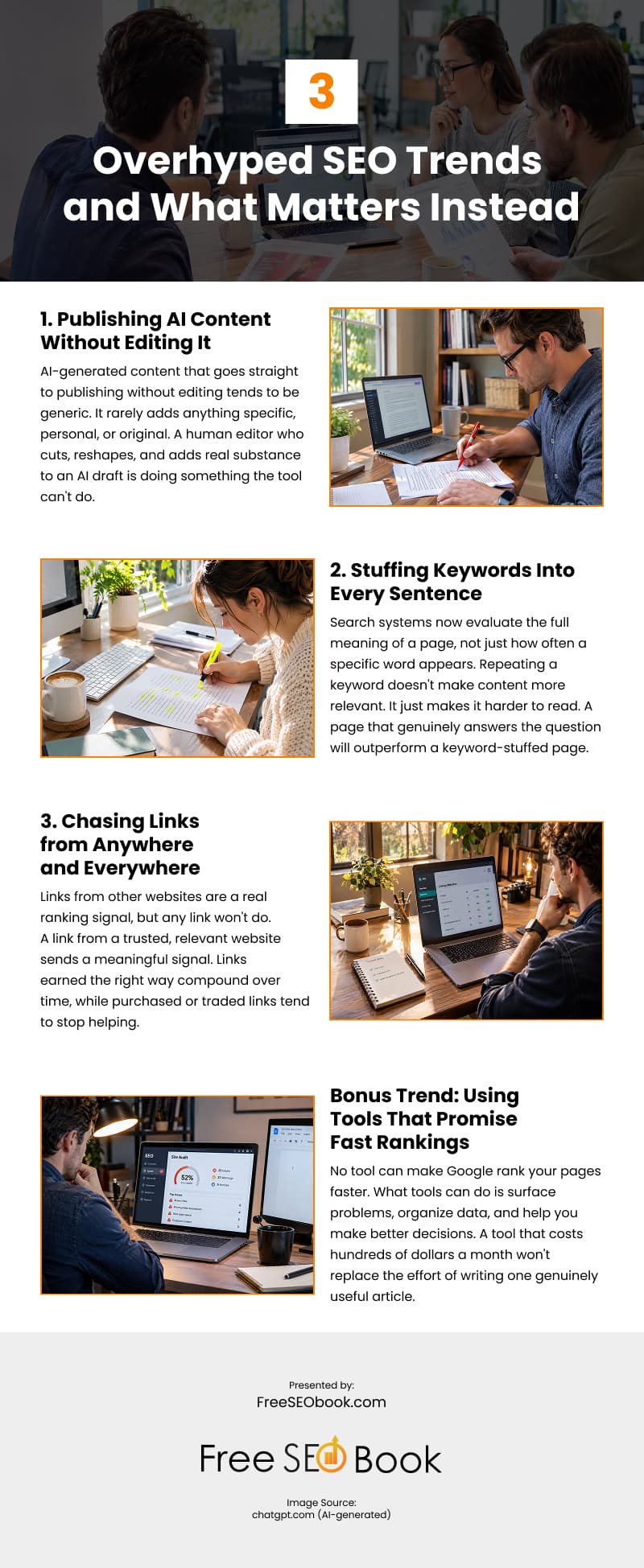
A new search engine optimization (SEO) trend shows up every few months. Each one promises a faster path to page one. Each one draws attention, generates content, and gets people talking.
Most of them don’t work.
The problem isn’t dishonesty. SEO simply doesn’t respond well to tricks. The fundamentals have stayed mostly the same for years. Trends come and go on top of them.
The businesses that rank consistently aren’t chasing what’s new. They’re doing the same unglamorous things they’ve always done, and doing them well.
1. Publishing AI Content Without Editing It
AI writing tools have become popular fast. They can produce a long article in seconds. That speed is appealing when you’re trying to create a lot of content quickly.
The problem is that speed without quality doesn’t produce rankings.
AI-generated content that goes straight to publishing without editing tends to be generic. It covers the same surface-level points as every other AI-generated article on the topic. It rarely adds anything specific, personal, or original.
It’s called AI slop for a reason.
Content that covers every topic the same way, with the same structure and the same broad examples, doesn’t stand out. Generic content doesn’t rank above specific content.
Google is increasingly good at recognizing this pattern and treating it accordingly.
The issue isn’t using AI tools. Many writers use them to speed up the drafting process. The issue is publishing whatever the tool produces without thinking critically about whether it actually serves the reader. A human editor who cuts, reshapes, and adds real substance to an AI draft is doing something the tool can’t do on its own.
Content that ranks well tends to say something specific. It answers the actual question a searcher has, not a generalized version of it. AI tools can help get words on the page. Making those words worth ranking requires more than that.
2. Stuffing Keywords Into Every Sentence
Keyword stuffing is exactly what it sounds like: repeating a keyword as many times as possible in a piece of content, hoping that repetition signals relevance to Google.
It doesn’t.
The technique became popular in the early days of search, when algorithms were simpler. Adding a keyword more often really did signal relevance back then. Google caught on. Search systems now evaluate the full meaning of a page, not just how often a specific word appears. Repeating a keyword doesn’t make content more relevant. It just makes it harder to read.
A page that mentions a keyword 40 times in 500 words reads as suspicious rather than authoritative. It tends to rank lower, not higher. Google is looking for content that actually covers a topic well, not content that hammers a phrase over and over.
Use your keyword where it fits naturally, usually in the title, the intro, and once or twice in the body. Then focus on covering the topic thoroughly. A page that genuinely answers the question will outperform a keyword-stuffed page every time.
3. Chasing Links from Anywhere and Everywhere
Links from other websites are a real ranking signal. More links from trusted sources generally mean more authority. That part is true.
What isn’t true is that any link will do.
A common shortcut is to pursue as many links from other sites as possible, regardless of their source. Link exchanges, paid link placements on low-quality sites, and comment spam all fall into this category. They produce a high link count on paper without producing real authority.
Google evaluates the source. A link from a trusted, relevant website sends a meaningful signal. A link from a site that exists mainly to sell links, or that covers completely unrelated topics, sends a much weaker signal, and in some cases a negative one.
The link shortcut is appealing because building real links is genuinely hard. It takes longer than any other part of SEO. But the difficulty is also what makes it valuable. A strong collection of quality links takes real effort to build, which is exactly why it’s hard to fake.
Links earned the right way compound over time. Purchased or traded links tend to stop helping, and sometimes start hurting.
Bonus Trend: Using Tools That Promise Fast Rankings
There are dozens of tools that will scan your site, study your competitors, give you a score, and tell you exactly what to fix to rank better. Some of them are genuinely useful.
The ones to be skeptical of are the ones that promise fast results.
No tool can make Google rank your pages faster. What tools can do is surface problems, organize data, and help you make better decisions. The value of any SEO tool depends entirely on what you do with what it tells you.
A common pattern is to subscribe to a tool, run a scan, find a list of issues, and feel like progress is happening because there’s a list of things to fix. Working through a list of technical issues can matter, but it rarely moves rankings as much as good content and earned links do. The tool is a lens. What you see through it still requires real work to improve.
A tool that costs hundreds of dollars a month won’t replace the effort of writing one genuinely useful article. The results come from the work, not from the subscription.
The businesses that rely most heavily on the latest tools are often the ones least focused on the fundamentals. Those ranking consistently tend to spend more time on content and less on dashboards.
What Actually Moves Rankings Over Time
The things that work in SEO aren’t secret. They haven’t changed much in years. They just require patience.
Content that covers a topic well, written for a real person trying to find an answer, remains the strongest foundation. A page that matches what someone actually searched for, gives them what they came to find, and holds their attention outperforms a cleverly optimized page that misses on those counts. No shortcut replaces this. The page either serves the reader or it doesn’t.
Site structure matters too. Pages that are easy to find, easy to read, and clearly connected to related content make it easier for both visitors and search engines to understand what a site is about.
Trust, built through consistently publishing useful content and earning links from credible sources, compounds over time. It can’t be faked quickly, but it also doesn’t evaporate when a trend fades.
SEO learning books that focus on these fundamentals will serve you better than ones built around trending tactics. Books built on real experience are written around what actually works, not around what’s currently generating buzz. The unglamorous version of SEO is the version that works.
Infographic