The first thing most beginners do when they decide to invest in search engine optimization (SEO) is start looking for answers online. That’s a reasonable instinct. But it’s also where most of the damage happens.
Online SEO content ranges from genuinely useful to actively misleading. Some of it is outdated advice that used to work. Some of it is only written to sell tools, services, or courses. And a fair amount is simply wrong.
Learning SEO for free is absolutely possible. So before you spend a dollar on anything SEO-related, it’s worth understanding the myths that cost beginners the most money.
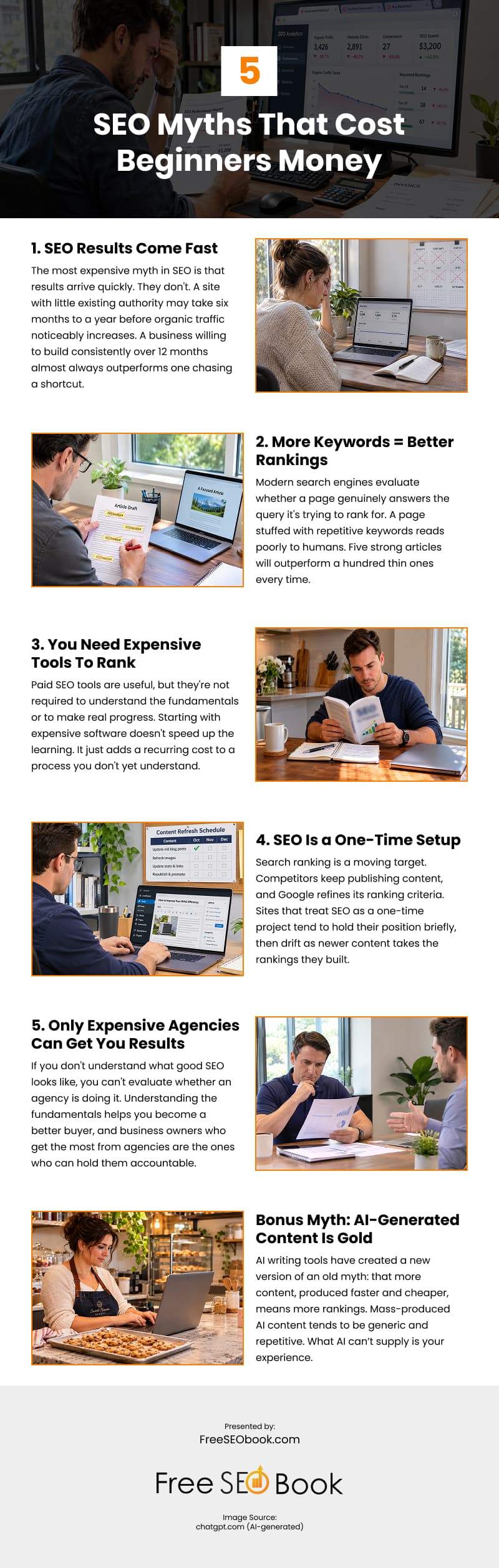
1. SEO Results Come Fast
The most expensive myth in SEO is that results arrive quickly.
They don’t.
Google needs time to crawl and reindex updated pages. New content can take months to earn a ranking. Even well-optimized pages don’t typically appear at the top of results the day they publish. A site with little existing authority may take six months to a year before organic traffic noticeably increases.
This myth survives because there’s a market for promising otherwise. Services offering fast rankings exist precisely because beginners expect fast results. They buy those services, see little change, assume SEO doesn’t work, and move on. The money is gone. And the site is roughly where it started.
What makes it worse is that fast-result services don’t just fail to deliver. Some actively harm the site. Low-quality links, thin content, and manipulative tactics can trigger penalties that take months to reverse. You end up paying again to fix the damage you paid to create.
The realistic timeline for SEO isn’t a flaw in the process. It’s the reason rankings hold once you earn them. A business willing to build consistently over 12 months almost always outperforms one chasing a shortcut.
2. More Keywords = Better Rankings
Packing a page with as many keywords as possible used to work two decades ago. But along with the rest of the internet, Google’s algorithms have evolved significantly since then.
Modern search engines evaluate whether a page genuinely answers the query it’s trying to rank for. They assess content depth, structure, relevance, and how users interact with the page after they arrive. A page stuffed with repetitive keywords reads poorly to humans and signals to Google that the content prioritizes manipulation over usefulness.
What actually improves rankings is content built around a clear search intent, meaning what the person searching actually wants to find or accomplish. One page, one topic, covered thoroughly. Related terms appear naturally when the content is written well. That means you need to answer the question better than the pages currently ranking above you.
This myth also drives a version of wasted spend that’s easy to fall into: buying bulk articles. The assumption is that more content equals more rankings. If the content isn’t built around genuine intent and doesn’t answer anything well, more content does nothing for you. Five strong articles will outperform a hundred thin ones every time.
3. You Need Expensive Tools To Rank
Paid SEO tools are useful. But they’re not required to understand the fundamentals or to make real progress. In fact, starting with them can hurt you in the long run.
Some of the best free SEO books for beginners come from business owners who built solid SEO expertise while growing their own companies. These authors write from hands-on experience with what actually moved rankings and traffic, not just theory.
Reading their work gives you a foundation that many paid courses skip entirely: the reasoning behind SEO decisions, not just the steps.
Paid platforms like Ahrefs and Semrush offer competitive analysis and keyword research capabilities, but those features are only useful once you understand what to do with the data. Buying a subscription before you have that foundation means paying for information you’re not equipped to act on.
The books written by experienced practitioners fill that gap first. They teach you how to think about SEO before you start relying on tools to execute it.
Starting with expensive software doesn’t speed up the learning. It just adds a recurring cost to a process you don’t yet understand.
4. SEO Is a One-Time Setup
Here’s a common assumption: optimize the site once, and the rankings follow.
That’s not how it works.
Search ranking is a moving target. Competitors keep publishing content. Google refines its ranking criteria. Pages that ranked well a year ago often need refreshing to stay competitive. New questions emerge in your market, creating search queries your existing content doesn’t address.
The content side of this is easy to underestimate. A page optimized today may outrank competitors six months from now. But if that page never gets updated, a competitor who refreshes their equivalent content next year can reclaim that position. Rankings aren’t permanent. They reflect the current state of what’s indexed, not the historical record of who got there first.
Sites that treat SEO as a one-time project tend to hold their position briefly, then drift. The organic traffic they earned slowly erodes as newer, more current content takes the rankings they built. The initial investment does produce results, but those results require maintenance to hold.
Committing to ongoing SEO from the start prevents the frustrating cycle of paying to rebuild what was allowed to slip.
5. Only Expensive Agencies Can Get You Results
Agencies can deliver real SEO value. But the ones that don’t tend to be very good at selling themselves to beginners who can’t tell the difference.
If you don’t understand what good SEO looks like, you can’t evaluate whether an agency is doing it. That’s where a lot of money disappears. An agency can report on traffic numbers and content published while producing work that has no real impact. Without a baseline understanding of what results should look like and how they’re achieved, those reports are easy to accept at face value.
There’s also a version of this myth that targets newer businesses specifically: the idea that competitors outrank you because they’re spending more on SEO services. Sometimes that’s true. But more often, they’re publishing more consistent, higher-quality content. That’s not a budget problem. It’s a strategy problem, and strategy is something you can learn.
Understanding the fundamentals helps you become a better buyer when you do hire someone. Knowing what to ask for, what metrics matter, and what work should actually be happening changes the vendor relationship entirely. Business owners who get the most from agencies are the ones who understand enough to hold them accountable.
Bonus Myth: AI-Generated Content Is Gold
AI writing tools have created a new version of an old myth: that more content, produced faster and cheaper, means more rankings. Beginners hear that they can publish dozens of articles a month for almost nothing, and it sounds like a shortcut.
It’s the same shortcut as keyword stuffing, just with better grammar (sometimes).
The issue isn’t that AI was involved. It’s what mass-produced AI content tends to be: generic, repetitive, and built from the same existing material that every competitor’s AI is drawing on. Search engines are designed to reward content that adds something new, and low-quality or duplicated text risks getting suppressed.
What AI can’t supply is your experience. It doesn’t know your story, your customers, or the lessons you learned the hard way. A bakery can write about cookies like everyone else, or it can write about the smell of a grandmother’s kitchen at the holidays. The second one is what makes readers relate, and people convert when they trust and relate to you, not just when they’re informed. Google also asks whether content shows real, first-hand experience, which is exactly what generic AI output lacks.
This is where the money disappears. Services that sell hundreds of AI-written articles for a flat fee are the modern bulk-article trap. You pay for volume, get thin content, and end up paying again to clean it up.
AI can still be useful for brainstorming topics, outlining, or editing. But the substance should come from you.
What To Do Before You Spend Anything
The pattern behind most of these myths is the same: beginners spend money before they understand what they’re buying.
The fix is simple.
Learn the fundamentals first. Read everything you can about SEO from qualified sources. Building that foundation before committing your budget to tools or services changes every decision that follows. You’ll ask better questions when evaluating agencies and make better decisions based on understanding rather than guesswork.
Infographic